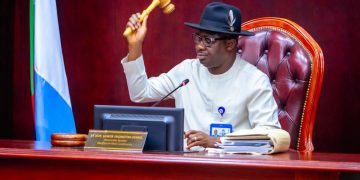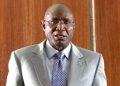


The Delta State House of Assembly has defended its decision to declare the seat of the former member representing Udu State Constituency vacant, insisting the action was a constitutional obligation rather than an act of political persecution.
The Office of the Speaker, in a statement signed by the Chief Press Secretary to the Speaker, Nkem Nwaeke, said allegations by the former lawmaker that he was politically victimised were “misleading” and contrary to the facts surrounding the development.
According to the statement, the House acted in strict compliance with Section 109(1)(g) of the 1999 Constitution (as amended), which requires a legislator elected on the platform of a political party to vacate his or her seat upon defecting to another political party, except where the defection is caused by a division within the sponsoring party or a merger of political parties.
The Speaker’s Office noted that the former Udu lawmaker voluntarily resigned from the All Progressives Congress (APC) and, in his resignation letter, stated that he was joining the Nigeria Democratic Congress (NDC) to pursue his political ambition.
It maintained that personal political aspiration is not one of the constitutional exceptions that allows a legislator to retain a seat after leaving the political party on whose platform the electoral mandate was obtained.
“The decision of the Delta State House of Assembly was taken strictly in accordance with the provisions of the Constitution of the Federal Republic of Nigeria, 1999 (as altered), which remains the supreme law governing the conduct of all public office holders, including members of the State Houses of Assembly,” the statement said.
The Speaker’s Office further argued that, as a legal practitioner, the former lawmaker was fully aware of the constitutional implications of his decision but had chosen to portray the outcome as persecution.
“Personal political ambition or aspiration is not one of the grounds recognised by the Constitution for retaining a legislative seat after abandoning the political party on whose platform the mandate was secured,” the statement added.
Beyond the issue of defection, the House also cited what it described as the former member’s prolonged absence from legislative activities.
According to official attendance records released by the Speaker’s Office, the lawmaker was absent from 22 plenary sittings during the First Session (June 2023–June 2024), 27 sittings during the Second Session (June 2024–June 2025), and 38 sittings during the Third Session (June 2025–June 2026).
The statement further alleged that the former legislator frequently failed to attend committee meetings and neglected his responsibilities as Chairman of the House Committee on Trade and Investment.
It also criticised his absence during Governor Sheriff Oborevwori’s presentation of the 2026 Appropriation Bill, describing the event as a constitutional and historic legislative occasion that traditionally requires the presence of all members.
The Speaker’s Office described the absence as inconsistent with parliamentary practice and harmful to the dignity and institutional integrity of the House.
“The declaration of his seat vacant merely formalised what had, in practical terms, become a prolonged disengagement from his legislative responsibilities,” the statement said.
The House maintained that it has a constitutional responsibility to safeguard the sanctity of electoral mandates and uphold the rule of law without fear or favour.
Rejecting allegations of political persecution, the Speaker’s Office urged members of the public to disregard what it described as unfounded claims.
“The declaration of his seat vacant was neither arbitrary nor politically motivated; it was a constitutional obligation imposed on the House by the supreme law of the Federal Republic of Nigeria,” the statement concluded.
It reaffirmed that the Delta State House of Assembly would continue to discharge its constitutional responsibilities with fairness, courage and fidelity to the rule of law.