
By Shedrack Onitsha
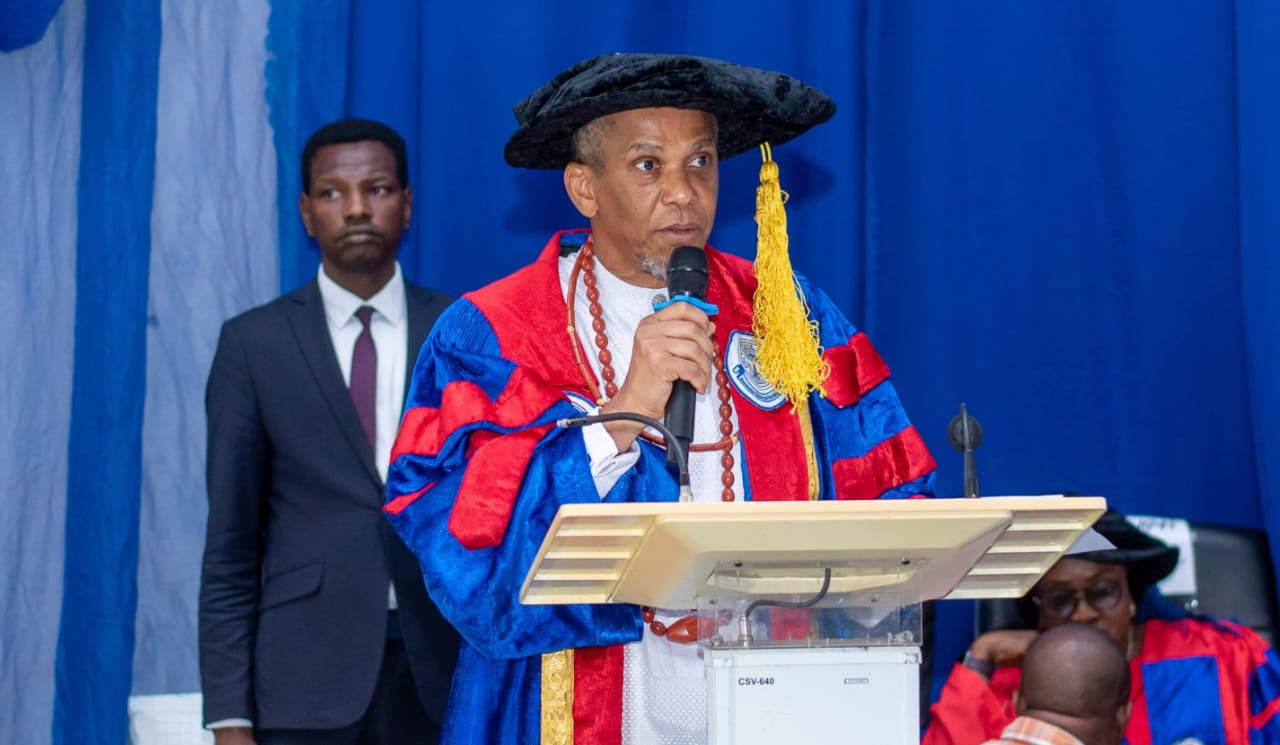
The 18th Convocation Ceremony of Delta State University, Abraka, served as a platform for a profound interrogation of the Nigerian state. Delivering the convocation lecture, Senator Ede Dafinone addressed the “graduating class of 2026” and distinguished guests, posing a fundamental question: why does vast potential translate into productivity so unevenly across nations? This inquiry set the stage for a deep dive into the strategies required for sustainable development in a nation gifted with immense resources yet burdened by structural frictions.
Senator Dafinone articulated the “Nigerian Paradox,” noting that while the country sits on 37 billion barrels of oil and over 70 million hectares of agricultural land, it remains home to some of the world’s highest rates of extreme poverty. He emphasized that potential—the raw capacity of a nation—is not synonymous with productivity. Productivity is the consistent application of that capacity within a system that amplifies effort. For Nigeria, the challenge lies in an environment that too often stunts growth through institutional decay and infrastructural deficits.
The lecture highlighted that sustainable development is not a one-off event or a ribbon-cutting ceremony. Instead, it is the result of repeated, disciplined, and institutionally reinforced behaviour sustained across generations. Dafinone pointed to success stories like South Korea, Singapore, and Botswana, noting that their transitions were not lottery wins but the result of building systems that protected human capital. He argued that human capital is the only form of capital capable of generating all others, making it the bedrock of national wealth.
A central theme of the address was the power of systems over individuals. Dafinone observed that a talented person in a broken system will inevitably produce broken results, whereas a modestly talented person in a well-designed system will thrive. This shift in perspective offers hope: national transformation does not require waiting for a “saviour” but necessitates a collective decision to build and protect institutions that make ordinary efforts extraordinarily productive.
Addressing the “governance deficit,” the Senator noted that while Nigeria has written good laws, they are often inconsistently applied. He stressed the importance of naming these problems precisely—from the gap between budget appropriation and execution to the capture of regulatory bodies by vested interests. Institutions are human constructs; therefore, the governance gap is not permanent but can be closed by a critical mass of principled, capable people committed to a functional state.
A significant portion of the lecture was dedicated to the restructuring of the global economy around knowledge. Dafinone argued that the shift from physical assets (land and minerals) to intangible assets (software, data, and creative content) offers Nigeria a time-limited opportunity to leapfrog traditional stages of development. In the knowledge economy, the geographic barriers that once separated a programmer in Port Harcourt from one in Silicon Valley have been lowered by digital infrastructure and global platforms.
The Senator celebrated the audacity of young Nigerians who have already begun to bridge this gap. He cited the founders of Paystack, Shola Akinlade and Ezra Olubi, as examples of engineers who build digital bridges that allow local businesses to compete globally. Similarly, the global success of artists like Wizkid and Burna Boy was presented as an early signal of what happens when Nigerian talent meets the right tools and the discipline to use them on a global stage.
The lecture provided a balanced view of Artificial Intelligence (AI), describing it as a “general-purpose technology” that reduces the cost of cognitive work. While AI cannot fix weak institutions or pave roads, it serves as a powerful capability amplifier for individuals. A researcher in Abraka can now use AI to synthesize data at speeds previously reserved for well-funded global teams. However, Dafinone warned that AI demands a higher level of “clear thinking” and human judgment to be effective.
Addressing the “japa” phenomenon—the migration of skilled Nigerians abroad—Dafinone offered an honest reckoning. He acknowledged the difficulties of the local environment but noted that the global North is also facing rapid restructuring and contracting immigration policies. He argued that the most enduring contributions to Nigeria often come from those who maintain an “orientation” toward building, whether they are in the diaspora or at home.
However, the Senator made a poignant plea for the “best and most capable” to stay and fight for the country from within. He described the perpetual drain of talent as a “slow, quiet catastrophe.” He argued that for Nigeria to move forward, it needs its most courageous citizens to help build the institutions that will eventually reward integrity, rather than leaving by default.
The lecture identified three fault lines that create the gap between policy and delivery in Nigeria: a lack of continuity across administrations, weak middle-level public institutions, and a cultural preference for “grand conception over patient execution.” Dafinone challenged the graduates to adopt an “execution culture”—the discipline of doing what one promised, at the quality promised, and on the schedule committed.
Deepening the focus on personal growth, the Senator spoke about the “quality of inner discipline.” In an age of unprecedented distraction, he warned that the most dangerous threat to a graduate’s future is not the economy, but the slow erosion of their own attention. He urged the class of 2026 to protect their “deep work” capacity, noting that those who can focus on hard problems will significantly outproduce those in a state of “continuous partial attention.”
On the subject of employment, the lecture highlighted a fundamental shift from “credential verification” to “competence verification.” Dafinone noted that while a degree is a necessary foundation, the global labor market now asks what a candidate can actually do. He pointed out that the tools to build this competence—online curricula from top-tier universities like MIT and Stanford—are now accessible to anyone in Abraka with an internet connection.
Senator Dafinone encouraged the graduates to view their formal education not as a finish line, but as a starting block. The next decade will belong to those who leave the ceremony asking: “What do I need to know that I do not yet know?” This proactive curiosity, combined with a willingness to build a portfolio of demonstrable skills, is what will distinguish the successful professional in the emerging economy.
The Senator reiterated that the uneven translation of potential into productivity is solved through sustained investment in human capital and an execution culture that honours delivery over intention. He acknowledged that the graduates are entering a “genuinely difficult” Nigeria, characterised by high unemployment and policy inconsistencies, but reminded them that such environments often produce the most consequential leaders.
The final charge to the class of 2026 was one of deliberate action. The potential of the nation belongs to them, but the productivity—the actual performance and prosperity—is a decision yet to be made. By choosing the “hard thing over the easy thing” and committing to disciplined, long-term growth, this generation can finally resolve the Nigerian Paradox and turn a gifted nation’s promise into a sustainable reality.
– Onitsha, FCIMS, MNIPR
A Media and Public Relations Consultant writes from Ughelli.