
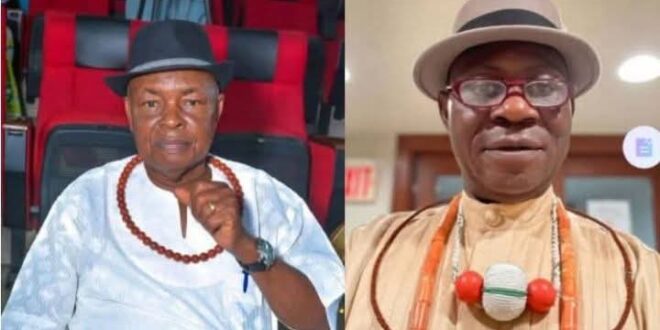
The re-election of Olorogun Ese Gam Owe as President-General of the Urhobo Progress Union (UPU) on Friday, December 5, 2025, at Urhobo House, Uvwiamuge, Agbarho, Delta State, has settled one question: who leads for the next term, but it has raised many others that the UPU cannot afford to ignore.
Winning 432 votes against Chief Simeon Ohwofa’s 178 is, by any electoral standard, a clear numerical victory. However, numbers alone do not resolve the deeper context surrounding this contest. For months ahead of the congress, critical assessments of the outgoing executive dominated the media and civic discussions. Several independent groups and commentators openly described the first tenure of the Ese Gam Owe leadership as underwhelming, citing unmet expectations on unity building, cultural promotion, global Urhobo coordination, and tangible development advocacy. These criticisms were not casual noise; they reflected a genuine mood of disappointment across sections of the Urhobo nation.
In contrast, Chief Simeon Ohwofa’s candidacy was framed around both pedigree and service: years of grassroots mobilisation, private support for Urhobo education and cultural activities, and a reputation for bridge-building. His campaign gained momentum from this narrative: change through experienced, people-centred leadership.
Yet, as the election drew closer, another narrative surfaced, more troubling than routine electoral rivalry, that alleged systematic plans to tilt the process in favour of the incumbent. Reports fingered the electoral committee led by Chief Emmanuel Ighomena and unnamed government interests. The claims ranged from voter accreditation manipulation to undue backstage pressure on delegates. No definitive proof has yet been publicly established, but the persistent presence of these accusations has cast an unavoidable shadow over the entire process.
The final results — a wide victory for a candidate whose tenure had faced intense public criticism — have not dispelled doubts. Rather, they sharpen them. When pre-election sentiment and post-election outcomes diverge dramatically, transparency becomes not optional but essential. Silence from election officials or the victorious camp deepens suspicion; openness would neutralise it.
That said, election outcomes must still be respected where no conclusive evidence of malpractice exists. Democracy cannot function on unverified allegations alone. However, legitimacy extends beyond legal validity. Moral legitimacy is built on trust, reconciliation, inclusiveness, and visible performance, all areas where the UPU leadership now faces serious challenges.
Olorogun Ese Gam Owe’s second tenure, therefore, begins under heightened scrutiny. The mandate he holds is not only to preside over committees and events; it is to reunify a divided Urhobo public and to prove, through concrete actions, that governance is more than internal politicking. The criticisms of his first term, whether fair or overstated, are not erased by re-election. They remain the scorecard he must now answer.
Equally important is the need for future UPU elections to rise above suspicion. Electoral committees must embrace open accreditation processes, publicly verifiable delegate lists, clear voting procedures, and prompt release of detailed result data. Without radical transparency, future contests risk descending into permanent legitimacy crises, outcomes accepted on paper but rejected in public conscience.
The Urhobo Progress Union stands at a sensitive crossroads. The election is over, but unity is not achieved by counting ballots alone. Leadership now must be measured by healing divisions, restoring public confidence, and delivering visible progress.
Ese Gam Owe has been returned to office, decisively in numbers, but legitimacy in history will be earned not from the ballot box of December 2025, but from the performance record that follows it.