
Community health advocate and founder of Maky Bloom Wellness Foundation, Stephanie Madumelu, is gaining recognition for a framework aimed at addressing a persistent public health failure which is health education that does not lead to care.
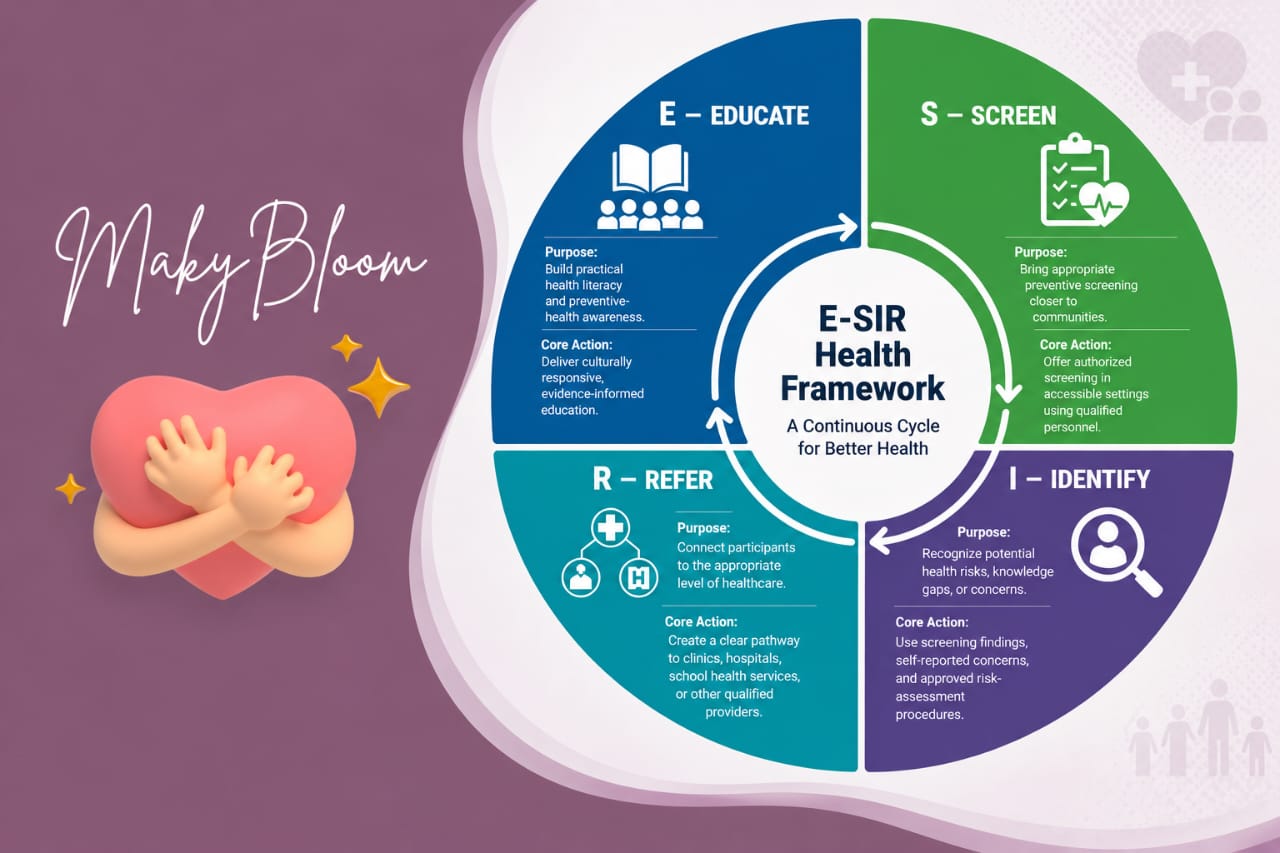
Madumelu, a public health professional based in Nigeria and the United States, developed the E-SIR model, an implementation framework that connects Education, Screening, Intervention, and Referral into a single community pathway.
The model was created in response to a pattern Madumelu observed during community outreach in schools and faith-based organisations: residents received health information but remained without access to screening, immediate response, or referral to services.
“E-SIR was designed to move people from awareness to action,” Madumelu said.
The premise behind the model is straightforward. Public health education can help people understand disease risks and prevention, but information by itself may have limited impact when individuals cannot access the services needed to act on what they have learned.
E-SIR attempts to address that disconnect by placing four stages of public health engagement within one structured pathway.
Education is the first stage, providing individuals with practical and culturally appropriate health information. Screening follows by creating opportunities to identify potential health concerns. Intervention provides an immediate response when a need is identified, while Referral connects individuals who require additional evaluation or services to appropriate healthcare or community resources.
The framework grew out of Madumelu’s community health work through Maky Bloom Wellness Foundation, an organisation focused on women’s health, reproductive health education, preventive health and community health literacy.
During outreach activities, the organisation has taken health programming beyond traditional clinical settings and into places where people already gather.
Schools have provided opportunities to engage students through menstrual and reproductive health education, while faith-based organisations have offered another point of entry for preventive health education and screening.
It was through these experiences, Madumelu said, that the limitations of one-time health education became increasingly apparent.
A person could learn about hypertension, for example, but still have no idea what their own blood pressure was. Screening could identify an abnormal reading, but without a defined next step, the individual could again be left to navigate the healthcare system alone.
E-SIR was developed to make those transitions part of the intervention itself.
The framework has since moved beyond its initial concept and is being implemented across schools, faith-based organisations and healthcare settings, allowing organisations to adapt the approach to the populations they serve.
Its application can look different in each environment.
In schools, the model can begin with age-appropriate health education and provide a structured response when additional support is needed. Faith-based and community organisations can combine health education with preventive screenings and connections to healthcare services. Healthcare organisations can participate in the intervention and referral components, helping establish continuity when individuals require further assessment or care.
That adaptability is an important feature of the model.
Rather than creating a program around one disease or one population, E-SIR provides an implementation structure that can be applied to different public health priorities while retaining the same sequence: educate, screen, intervene and refer.
Madumelu’s work has focused particularly on populations that experience barriers to preventive healthcare and health information, including women and underserved communities.
Through Maky Bloom Wellness Foundation, she has led community initiatives involving menstrual and reproductive health education, sanitary health resources, blood pressure and blood glucose screening, and referrals for individuals requiring further medical attention.
The work reflects a broader shift in community health toward meeting people outside conventional healthcare facilities and connecting those encounters with formal systems of care.
For Madumelu, that connection is central to the purpose of E-SIR.
Health education may begin the process, but the intended outcome is not simply a more informed community. It is a community in which information can lead to screening, identified needs can lead to intervention, and people who require additional care have a clearer pathway to receiving it.
As the framework continues to be implemented in different community and institutional environments, E-SIR represents Madumelu’s effort to turn a recurring public health gap into a structured and replicable response.