

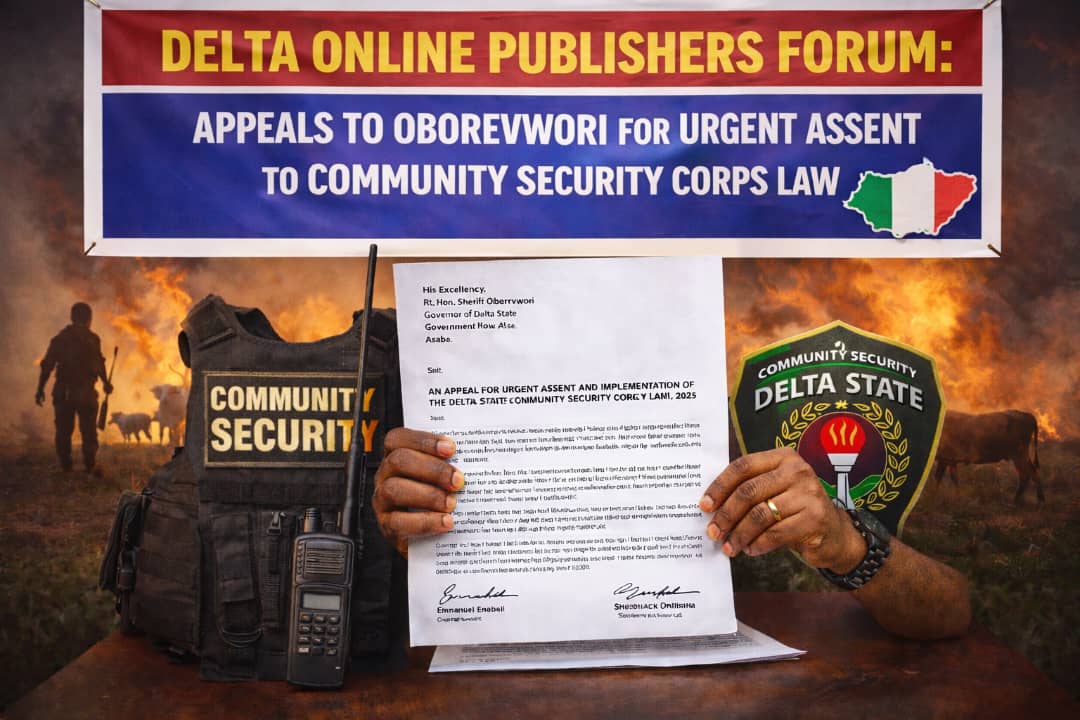
The Delta Online Publishers Forum (DOPF) has appealed to Governor Sheriff Oborevwori to urgently assent to and implement the Delta State Community Security Corps Agency Law, 2025, warning that continued delay could further expose communities to violent crimes.
In a letter jointly signed by its Chairman, Emmanuel Enebeli, and Secretary, Shedrack Onitsha, the Forum expressed concern over escalating insecurity across the state, particularly attacks on farmers by armed herdsmen, kidnapping for ransom, and other violent crimes threatening livelihoods, food security, and public confidence.
DOPF recalled that the Community Security Corps Agency Law was duly passed by the Delta State House of Assembly on July 22, 2025, after third reading.
The law, sponsored by the Chairman of the House Committee on Peace and Security, Hon. Isaac Anwuzia, repeals the 2020 version and introduces a more structured and legally grounded framework for community-based security.
According to the Forum, the law is designed to strengthen Delta State’s security architecture by establishing a formal community security agency capable of complementing conventional security forces, improving intelligence gathering, and responding swiftly to grassroots security threats, similar to the Amotekun model in the South-West.
While commending Governor Oborevwori for assenting to the Delta State Anti-Terrorism and Anti-Cultism (Amendment) Law, 2025, and inaugurating the Delta State Security Trust Fund, DOPF expressed concern that the Community Security Corps Agency Law—described as the operational backbone for effective grassroots security—has remained unsigned for several months after passage.
The Forum warned that the delay mirrors the fate of the Delta State Anti-Open Grazing Law, which, despite being enacted in the previous administration, has largely remained unenforced even as violent attacks on farms persist.
It noted that laws without enforcement structures risk becoming symbolic rather than protective.
DOPF further raised concerns about emerging security threats, citing fears that criminal and terrorist elements displaced from other regions could seek refuge in parts of the Niger Delta, thereby worsening the state’s security challenges.
The Forum stressed that assenting to the law should be accompanied by immediate implementation measures, including clear recruitment guidelines, training standards, funding mechanisms, oversight frameworks, and coordination protocols with existing security agencies.
Describing the law as critical to protecting lives, investments, and farmlands, DOPF urged the governor to treat its signing and implementation as a New Year reassurance to Deltans that their safety remains a priority of his administration.