

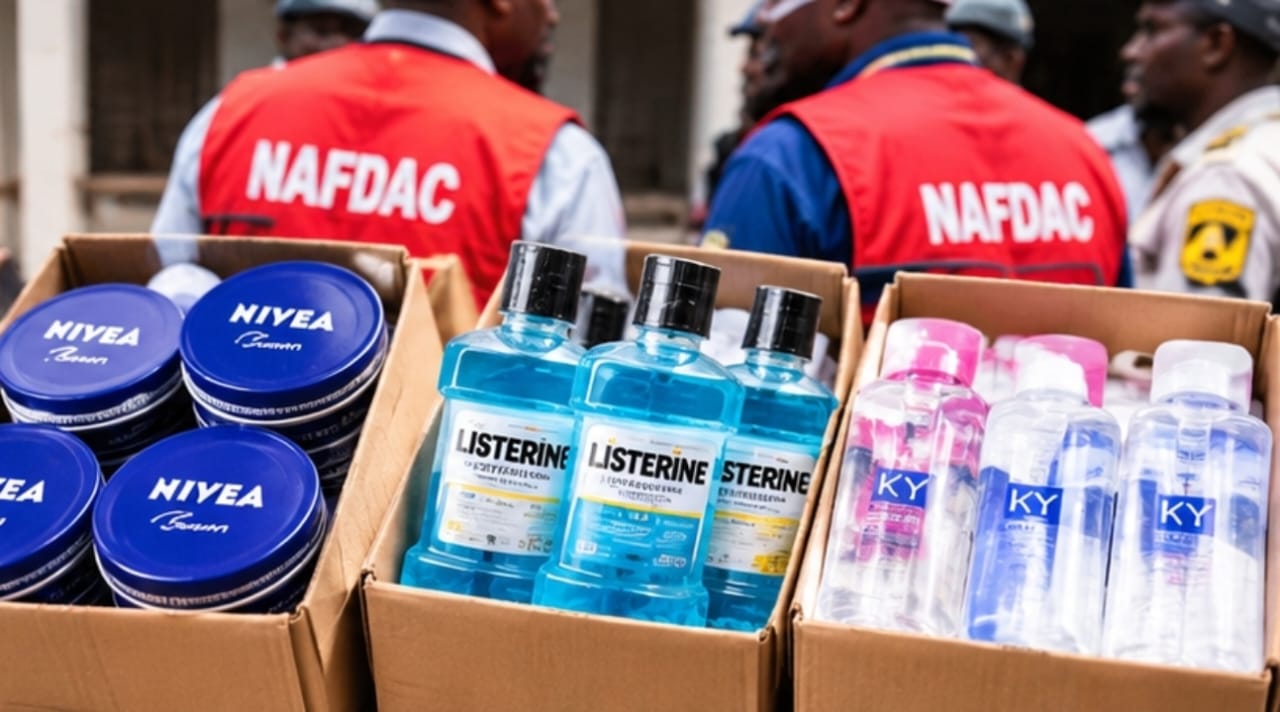
The National Agency for Food and Drug Administration and Control (NAFDAC) has raided parts of Igbudu Market in Warri, Delta State, confiscating suspected counterfeit cosmetics and other regulated products, including items bearing the Nivea and Listerine brand names.
The enforcement operation, conducted on November 6, was carried out by officials from the agency’s Asaba Zonal Office with support from the Department of State Services (DSS), the Nigerian Army and the market union.
According to information released by NAFDAC, the operation targeted identified shops and locations within the market, where suspected counterfeit products were discovered and evacuated.
Among the items seized were suspected counterfeit products bearing the Nivea and Listerine names. The agency did not disclose the quantities recovered, their estimated market value or whether laboratory tests had been completed to establish their authenticity.
NAFDAC also issued a warning concerning KY Jelly lubricant currently circulating in the market.
The agency said the product’s marketing authorisation holders had confirmed that the last authorised supply was made more than five years ago. It consequently advised consumers to treat KY Jelly products currently found in circulation as suspect.
The warning raises concerns about the possible circulation of products whose source, storage conditions and regulatory status cannot be verified.
NAFDAC also dismissed social media claims that its officers were attacked or chased out of Igbudu Market during the enforcement exercise.
The agency maintained that the operation was successfully completed, with its personnel accessing the identified locations and evacuating the suspected offending products.
The development is a reminder of the risks associated with counterfeit and unregulated personal-care products, particularly those applied to the skin or used for intimate health.
Consumers are advised to purchase cosmetics, mouth-care products and personal lubricants from reputable outlets, examine product packaging and registration details, and avoid items whose authenticity cannot be established.
The agency’s warning on KY Jelly is particularly important: consumers should not assume that a product is genuine simply because it is displayed for sale in a familiar retail outlet.