
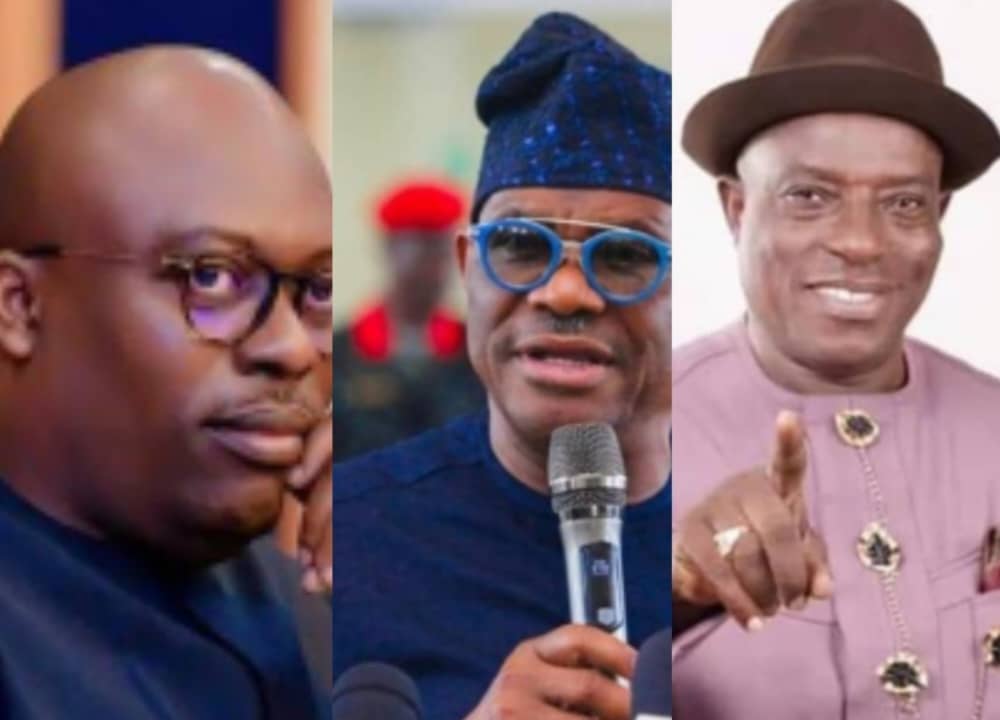
Recent comments credited to the All Progressives Congress (APC) National Vice Chairman for the South-South, Hon. Victor Giadom, have reopened long-standing debates about political authority, party hierarchy and influence in Rivers State, while also reflecting a broader pattern that has played out across Nigeria’s political landscape. Giadom’s assertion that Governor Siminalayi Fubara would need to “go through” Minister of the Federal Capital Territory, Nyesom Wike, to “win anything” politically in the state has generated sharp reactions, particularly on social media, with critics interpreting the remark as an insult to the office of the governor and a challenge to established political norms.
In Nigerian political practice, governors are commonly regarded as leaders of their party structures at the state level. This understanding, though not always explicitly codified in party constitutions, is reinforced by governors’ control over state resources, appointments and electoral machinery. It is also a principle that has been publicly affirmed in the past by Vice President Kashim Shettima, lending weight to the argument that a sitting governor should not be politically subordinated to any other figure within the same party. From this perspective, Giadom’s statement appears to run against accepted convention.
Yet Nigerian politics has never operated on formal authority alone. Alongside official power, informal influence often plays an equally decisive role. Across the country, former governors and entrenched political figures have continued to shape outcomes long after leaving office, sometimes exerting greater control over party structures than sitting governors. States such as Kano, Ogun, Imo, Zamfara, Oyo and Lagos have all experienced periods where legacy power blocs constrained or overshadowed incumbents. In this sense, Rivers State is not an outlier but part of a recurring national pattern.
Nyesom Wike’s continued relevance fits squarely within this tradition. As a former two-term governor with deep grassroots networks and a long history of political mobilisation, Wike remains a dominant force in Rivers politics, particularly in parts of the state such as Gokana and other Ogoni areas. His influence is widely acknowledged by political actors across party lines and did not dissipate with his exit from office. Giadom’s remark, while politically injudicious in tone, can therefore be read less as a constitutional claim and more as a blunt assessment of prevailing power realities.
Public reactions to the controversy have also been shaped by misconceptions, notably the claim that Wike is not a member of the APC. That position is no longer accurate. Wike formally aligned with the APC in 2025 following months of political realignment after the 2023 elections, and his role as a minister in an APC-led federal government further confirms his standing within the ruling party. Consequently, arguments that Governor Fubara has no political business engaging Wike on the basis of party affiliation lack factual grounding.
The Rivers debate also echoes national leadership dynamics within the APC. Historically, no former Lagos State governor emerged as party leader through a governors’ platform. Even President Bola Tinubu, despite being widely acknowledged as a foundational figure within the party, did not ascend to APC leadership through state governors before becoming president in 2023. Similarly, under former President Muhammadu Buhari, the APC operated with multiple centres of influence, and internal disputes during his tenure highlighted the limits of presidential authority over party machinery. These precedents underscore the reality that party leadership in Nigeria is often fluid, contested and negotiated rather than rigidly defined.
What distinguishes the Rivers episode is not the existence of dual power centres, which is common across states, but the unusual public bluntness with which the issue was articulated by a national party officer. In many states, such power balances are managed discreetly to preserve party cohesion and public optics. By stating the reality openly, Giadom transformed an informal political truth into a public controversy, provoking emotional backlash rather than strategic recalibration.
The episode also reflects a post-2023 trend in which federal appointees, particularly ministers with direct access to the centre, wield increasing influence over state-level politics. Similar dynamics have been observed in states such as Abia, Benue and Cross River, where federal power has reshaped local party equations. Under President Tinubu’s administration, ministers have enjoyed considerable political latitude, further blurring the lines between formal state leadership and national influence.
Ultimately, the controversy underscores a familiar tension in Nigerian politics between constitutional office and entrenched power. Governors may hold formal authority, but political success often depends on navigating inherited structures and negotiating with influential stakeholders who command loyalty beyond official institutions. Calls for Giadom’s removal, while emotionally resonant among supporters of the governor, are unlikely to be resolved through outrage alone. Party discipline, internal mechanisms and strategic calculation will determine the outcome.
As Rivers State continues to navigate its post-transition political terrain, the challenge before Governor Fubara will be to consolidate authority without underestimating existing power networks. For the APC, the episode highlights the need for disciplined messaging and internal cohesion as the party positions itself ahead of future electoral contests. More broadly, the controversy reinforces an enduring truth of Nigerian politics: power is not defined solely by office, but by influence, negotiation and the ability to command loyalty across competing structures.