
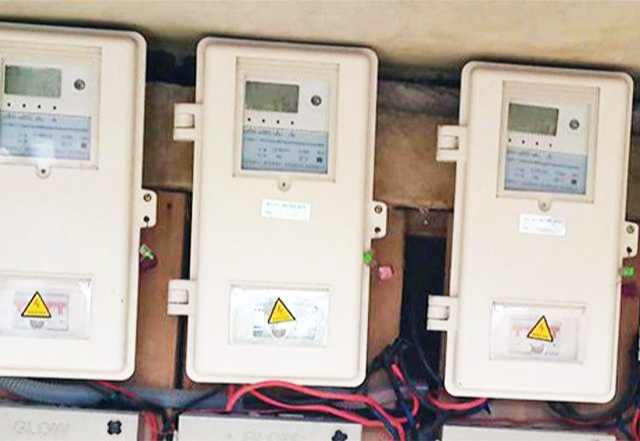
The Federal Government has outlawed the collection of fees for electricity meter installation, warning distribution companies (DisCos) and their agents that any form of extortion will attract prosecution.
Minister of Power, Adebayo Adelabu, issued the warning on Thursday at APM Terminals, Apapa, Lagos, while inspecting a fresh consignment of smart meters imported under the World Bank–supported Distribution Sector Recovery Programme (DISREP).
“These meters are free—completely free,” Adelabu declared. “No DisCo official, no installer, nobody has the right to collect a single naira from any consumer. Anyone who does so is committing an offence.”
The minister inspected about 500,000 newly arrived meters, part of a nationwide rollout aimed at eliminating Nigeria’s long-standing metering gap.
He disclosed that the Federal Government plans to deploy about 3.4 million meters in two phases, with 1.43 million allocated to the first phase.
Nearly one million meters have already arrived in the country, while about 150,000 have been installed so far.
Describing the initiative as a decisive shift from rhetoric to action, Adelabu said the large-scale deployment marked a turning point for a power sector burdened by estimated billing and deep consumer mistrust.
“For the first time, government is physically delivering meters at this scale,” he said.
“This is not policy talk; this is implementation.”
He stressed that the free meter policy applies to all electricity consumers, irrespective of tariff band. “Band A, B or C makes no difference. Every customer is covered. The era of paying for meters is over,” he said.
While admitting that installation has been slower than expected, the minister assured that the pace would improve as data-related challenges are resolved.
He also announced plans to establish customer complaint desks nationwide and urged Nigerians to report any demand for money by DisCo staff or installers.
“We will track this process from end to end,” Adelabu warned. “Any confirmed case of extortion—no matter how senior the official—will lead to prosecution, and it will be publicised to serve as a deterrent.”
According to him, full metering will improve billing transparency, restore consumer confidence and strengthen liquidity in the power sector.
“When people are billed fairly, they are more willing to pay. That is how the system becomes sustainable,” he said.
Director-General of the Bureau of Public Enterprises (BPE), Ayo Gbeleyi, said the Nigerian Electricity Regulatory Commission (NERC) would soon issue additional directives to address delays by some DisCos and ensure unhindered access for meter installation.
He noted that deployment is being monitored in real time, adding that each meter is configured for a specific distribution company and equipped with anti-theft features.
“A meter assigned to Eko DisCo, for example, cannot be used elsewhere,” he said.
Chairman of meter manufacturing firm Mojec, Mrs. Mojisola Abdul, also reiterated that the meters being deployed are free of charge.
“Consumers should not give anyone money,” she said. “Once registered under the mobile registration scheme, installation can be completed within three days.”
Acknowledging widespread public scepticism fueled by years of unfulfilled promises, Adelabu said the current programme is different due to sufficient meter volumes and strict enforcement.
“In the past, meters were scarce and people had to pay,” he said. “Now, the supply is available and the rules are clear. The old bottlenecks are being dismantled.”
The minister also inspected the National Meter Test Station in Oshodi, where meters are certified by the Nigerian Electricity Management Services Agency before deployment.
Nigeria currently has over five million electricity customers on estimated billing, a situation the Federal Government says this aggressive metering drive is designed to end.